 Add to Chrome
 Add to Firefox
 Add to Edge
Interpreting and Enhancing Emotional Circuits in Large Vision-Language Models via Cross-Modal Information Flow
May 21, 2026
Large Vision-Language Models (LVLMs) represent a significant leap towards empathetic agents, demonstrating remarkable capabilities in emotion understanding. However, the internal mechanisms governing how LVLMs translate abstract visual stimuli into coherent emotional narratives remain largely unexplored, primarily due to the scarcity of visual counterfactuals and the diffuse nature of emotional expression. In this paper, we bridge this gap by introducing a steering-vector-based causal attribution framework tailored for descriptive emotional reasoning. To this end, we construct a specialized dataset to demystify the emotional circuits underlying the three-stage ``Adapt-Aggregate-Execute'' mechanism. Crucially, we discover a functional decoupling: visual emotional cues are aggregated in middle layers via sentiment-specific attention heads, but are subsequently translated into narrative generation in deep layers through emotion-general pathways. Guided by these insights, we regulate the emotional information routing to strengthen attention flow and amplify the semantic activation to consolidate expression. Extensive experiments on the comprehensive MER-UniBench demonstrate that our methods significantly improve performance via inference-time intervention, effectively mitigating emotional hallucinations and corroborating the causal fidelity of the discovered circuits.

MOSS: Self-Evolution through Source-Level Rewriting in Autonomous Agent Systems
May 21, 2026Autonomous agentic systems are largely static after deployment: they do not learn from user interactions, and recurring failures persist until the next human-driven update ships a fix. Self-evolving agents have emerged in response, but all confine evolution to text-mutable artifacts -- skill files, prompt configurations, memory schemas, workflow graphs -- and leave the agent harness untouched. Since routing, hook ordering, state invariants, and dispatch live in code rather than in any text artifact, an entire class of structural failure is physically unreachable from the text layer. We argue that source-level adaptation is a fundamentally more general medium: it is Turing-complete, a strict superset of every text-mutable scope, takes effect deterministically rather than through base-model compliance, and does not erode under long-context drift. We present MOSS, a system that performs self-rewriting at the source level on production agentic substrates. Each evolution is anchored to an automatically curated batch of production-failure evidence and proceeds through a deterministic multi-stage pipeline; code modification is delegated to a pluggable external coding-agent CLI while MOSS retains stage ordering and verdicts. Candidates are verified by replaying the batch against the candidate image in ephemeral trial workers, then promoted via user-consent-gated, in-place container swap with health-probe-gated rollback. On OpenClaw, MOSS lifts a four-task mean grader score from 0.25 to 0.61 in a single cycle without human intervention.
Prefill-Time Intervention for Mitigating Hallucination in Large Vision-Language Models
Apr 28, 2026Large Vision-Language Models (LVLMs) have achieved remarkable progress in visual-textual understanding, yet their reliability is critically undermined by hallucinations, i.e., the generation of factually incorrect or inconsistent responses. While recent studies using steering vectors demonstrated promise in reducing hallucinations, a notable challenge remains: they inadvertently amplify the severity of residual hallucinations. We attribute this to their exclusive focus on the decoding stage, where errors accumulate autoregressively and progressively worsen subsequent hallucinatory outputs. To address this, we propose Prefill-Time Intervention (PTI), a novel steering paradigm that intervenes only once during the prefill stage, enhancing the initial Key-Value (KV) cache before error accumulation occurs. Specifically, PTI is modality-aware, deriving distinct directions for visual and textual representations. This intervention is decoupled to steer keys toward visually-grounded objects and values to filter background noise, correcting hallucination-prone representations at their source. Extensive experiments demonstrate PTI's significant performance in mitigating hallucinations and its generalizability across diverse decoding strategies, LVLMs, and benchmarks. Moreover, PTI is orthogonal to existing decoding-stage methods, enabling plug-and-play integration and further boosting performance. Code is available at: https://github.com/huaiyi66/PTI.
Weight Patching: Toward Source-Level Mechanistic Localization in LLMs
Apr 15, 2026Mechanistic interpretability seeks to localize model behavior to the internal components that causally realize it. Prior work has advanced activation-space localization and causal tracing, but modules that appear important in activation space may merely aggregate or amplify upstream signals rather than encode the target capability in their own parameters. To address this gap, we propose Weight Patching, a parameter-space intervention method for source-oriented analysis in paired same-architecture models that differ in how strongly they express a target capability under the inputs of interest. Given a base model and a behavior-specialized counterpart, Weight Patching replaces selected module weights from the specialized model into the base model under a fixed input. We instantiate the method on instruction following and introduce a framework centered on a vector-anchor behavioral interface that provides a shared internal criterion for whether a task-relevant control state has been formed or recovered in open-ended generation. Under this framework, the analysis reveals a hierarchy from shallow candidate source-side carriers to aggregation and routing modules, and further to downstream execution circuits. The recovered component scores can also guide mechanism-aware model merging, improving selective fusion across the evaluated expert combinations and providing additional external validation.
Drawback of Enforcing Equivariance and its Compensation via the Lens of Expressive Power
Dec 10, 2025Equivariant neural networks encode symmetry as an inductive bias and have achieved strong empirical performance in wide domains. However, their expressive power remains not well understood. Focusing on 2-layer ReLU networks, this paper investigates the impact of equivariance constraints on the expressivity of equivariant and layer-wise equivariant networks. By examining the boundary hyperplanes and the channel vectors of ReLU networks, we construct an example showing that equivariance constraints could strictly limit expressive power. However, we demonstrate that this drawback can be compensated via enlarging the model size. Furthermore, we show that despite a larger model size, the resulting architecture could still correspond to a hypothesis space with lower complexity, implying superior generalizability for equivariant networks.
Enhancing Target-unspecific Tasks through a Features Matrix
May 07, 2025Recent developments in prompt learning of large vision-language models have significantly improved performance in target-specific tasks. However, these prompt optimizing methods often struggle to tackle the target-unspecific or generalizable tasks effectively. It may be attributed to the fact that overfitting training causes the model to forget its general knowledge having strong promotion on target-unspecific tasks. To alleviate this issue, we propose a novel Features Matrix (FM) regularization approach designed to enhance these models on target-unspecific tasks. Our method extracts and leverages general knowledge, shaping a Features Matrix (FM). Specifically, the FM captures the semantics of diverse inputs from a deep and fine perspective, preserving essential general knowledge, which mitigates the risk of overfitting. Representative evaluations demonstrate that: 1) the FM is compatible with existing frameworks as a generic and flexible module, and 2) the FM significantly showcases its effectiveness in enhancing target-unspecific tasks, achieving state-of-the-art performance.
* ICML 2025
Leveraging Submodule Linearity Enhances Task Arithmetic Performance in LLMs
Apr 15, 2025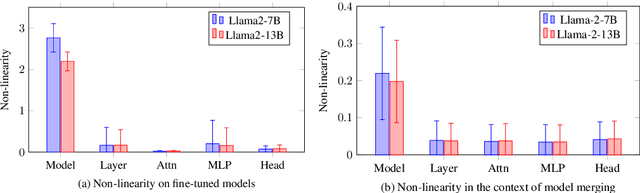
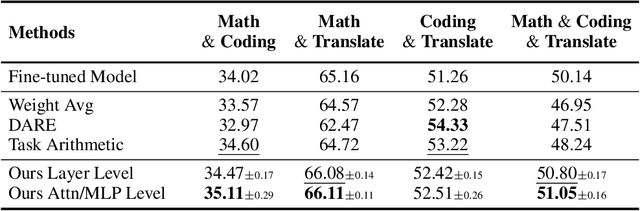
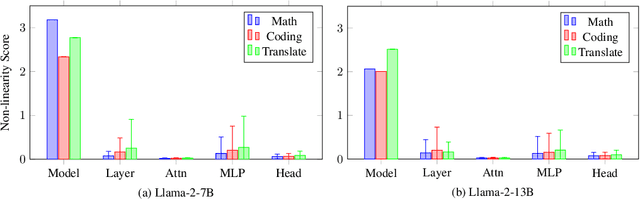
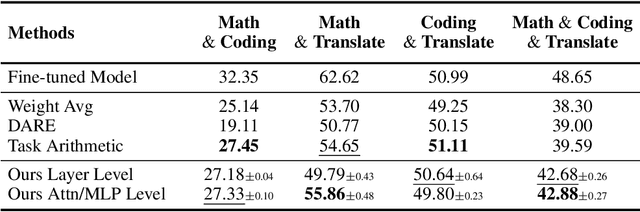
Task arithmetic is a straightforward yet highly effective strategy for model merging, enabling the resultant model to exhibit multi-task capabilities. Recent research indicates that models demonstrating linearity enhance the performance of task arithmetic. In contrast to existing methods that rely on the global linearization of the model, we argue that this linearity already exists within the model's submodules. In particular, we present a statistical analysis and show that submodules (e.g., layers, self-attentions, and MLPs) exhibit significantly higher linearity than the overall model. Based on these findings, we propose an innovative model merging strategy that independently merges these submodules. Especially, we derive a closed-form solution for optimal merging weights grounded in the linear properties of these submodules. Experimental results demonstrate that our method consistently outperforms the standard task arithmetic approach and other established baselines across different model scales and various tasks. This result highlights the benefits of leveraging the linearity of submodules and provides a new perspective for exploring solutions for effective and practical multi-task model merging.
A Theoretical Perspective: How to Prevent Model Collapse in Self-consuming Training Loops
Feb 26, 2025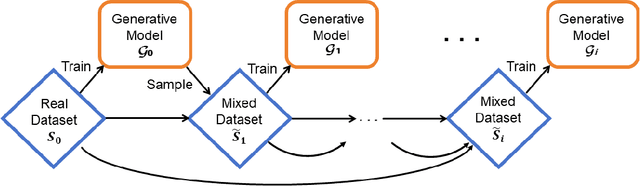
High-quality data is essential for training large generative models, yet the vast reservoir of real data available online has become nearly depleted. Consequently, models increasingly generate their own data for further training, forming Self-consuming Training Loops (STLs). However, the empirical results have been strikingly inconsistent: some models degrade or even collapse, while others successfully avoid these failures, leaving a significant gap in theoretical understanding to explain this discrepancy. This paper introduces the intriguing notion of recursive stability and presents the first theoretical generalization analysis, revealing how both model architecture and the proportion between real and synthetic data influence the success of STLs. We further extend this analysis to transformers in in-context learning, showing that even a constant-sized proportion of real data ensures convergence, while also providing insights into optimal synthetic data sizing.
A Similarity Paradigm Through Textual Regularization Without Forgetting
Feb 20, 2025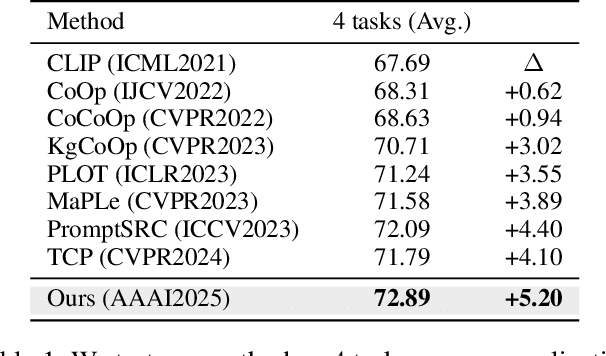
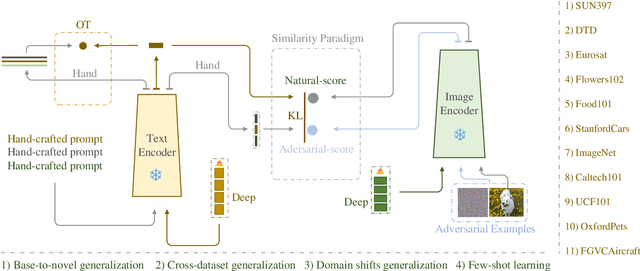
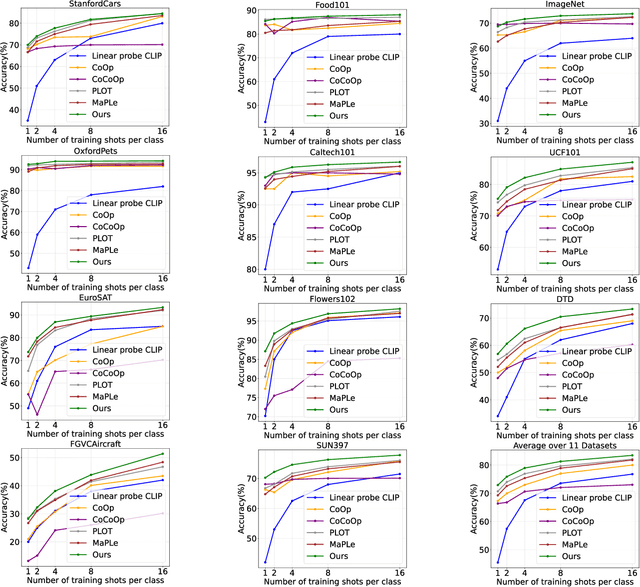
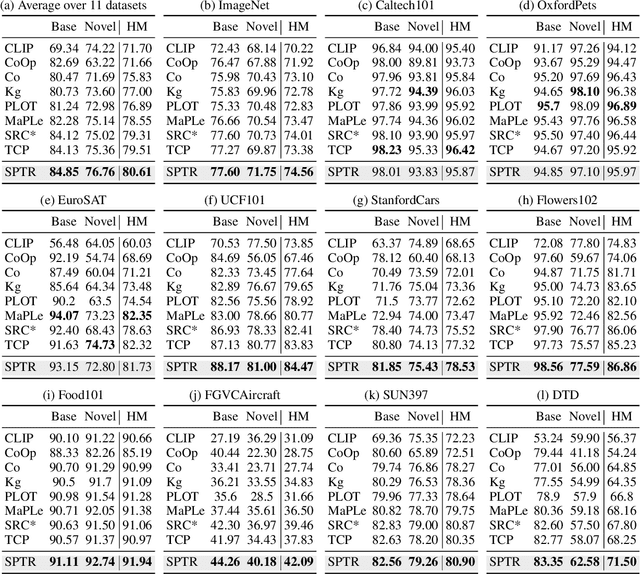
Prompt learning has emerged as a promising method for adapting pre-trained visual-language models (VLMs) to a range of downstream tasks. While optimizing the context can be effective for improving performance on specific tasks, it can often lead to poor generalization performance on unseen classes or datasets sampled from different distributions. It may be attributed to the fact that textual prompts tend to overfit downstream data distributions, leading to the forgetting of generalized knowledge derived from hand-crafted prompts. In this paper, we propose a novel method called Similarity Paradigm with Textual Regularization (SPTR) for prompt learning without forgetting. SPTR is a two-pronged design based on hand-crafted prompts that is an inseparable framework. 1) To avoid forgetting general textual knowledge, we introduce the optimal transport as a textual regularization to finely ensure approximation with hand-crafted features and tuning textual features. 2) In order to continuously unleash the general ability of multiple hand-crafted prompts, we propose a similarity paradigm for natural alignment score and adversarial alignment score to improve model robustness for generalization. Both modules share a common objective in addressing generalization issues, aiming to maximize the generalization capability derived from multiple hand-crafted prompts. Four representative tasks (i.e., non-generalization few-shot learning, base-to-novel generalization, cross-dataset generalization, domain generalization) across 11 datasets demonstrate that SPTR outperforms existing prompt learning methods.
HRP: High-Rank Preheating for Superior LoRA Initialization
Feb 11, 2025This paper studies the crucial impact of initialization on the convergence properties of Low-Rank Adaptation (LoRA). We theoretically demonstrate that random initialization, a widely used schema, will likely lead LoRA to random low-rank results, rather than the best low-rank result. While this issue can be mitigated by adjusting initialization towards a well-informed direction, it relies on prior knowledge of the target, which is typically unknown in real-world scenarios. To approximate this well-informed initial direction, we propose High-Rank Preheating (HRP), which fine-tunes high-rank LoRA for a few steps and uses the singular value decomposition of the preheated result as a superior initialization. HRP initialization is theory-supported to combine the convergence strengths of high-rank LoRA and the generalization strengths of low-rank LoRA. Extensive experiments demonstrate that HRP significantly enhances LoRA's effectiveness across various models and tasks, achieving performance comparable to full-parameter fine-tuning and outperforming other initialization strategies.